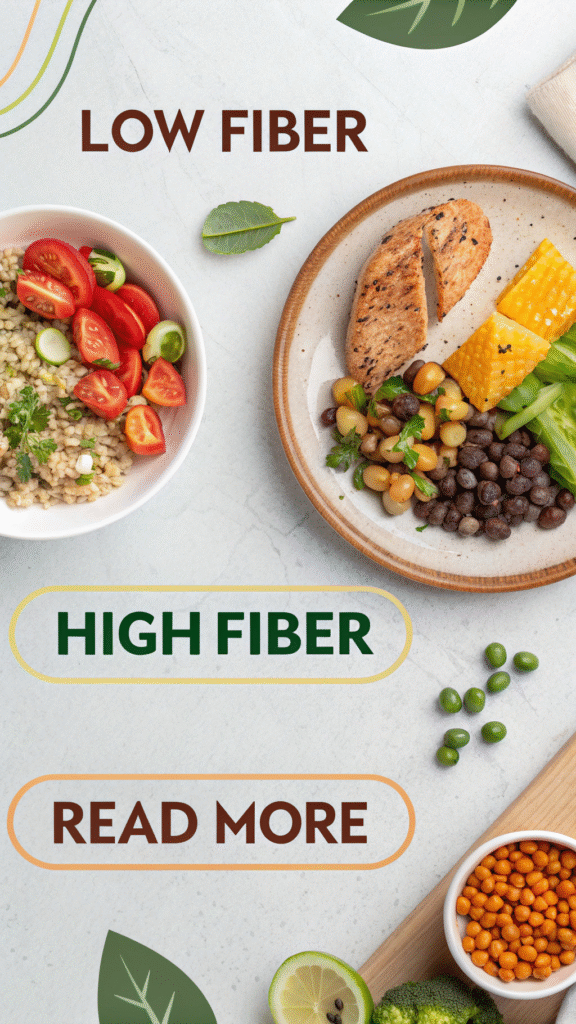
I was sitting across from my gastroenterologist feeling completely confused.
“So wait,” I said. “During a flare-up, you want me to eat LOW fiber?”
“Yes,” she nodded.
“But to prevent flare-ups, I need HIGH fiber?”
“Exactly.”
I stared at her. “That makes no sense. Fiber is either good or bad. Which is it?”
She smiled. “Both. It depends on where you are in your healing.”
That conversation was three years ago. I’ve learned the hard way that timing is everything with diverticulitis.
Eat high fiber during a flare-up? Pain gets worse.
Eat low fiber when you’re healed? More flare-ups happen.
The key is knowing exactly when to switch. Get the timing wrong and you’ll suffer. Get it right and you’ll heal faster and stay healthy longer.
Here’s everything I learned about low-fiber versus high-fiber diets and the exact signals that tell you when to switch.
Why Fiber Is Both Your Friend and Your Enemy
Fiber is weird. It’s the only food advice that completely reverses depending on your situation.
During inflammation: Fiber is like sandpaper on an open wound. It irritates your inflamed colon. Makes pain worse. Slows healing.
When healthy: Fiber is protective. It keeps your colon moving smoothly. Prevents new pouches from forming. Reduces flare-up risk by 50%.
Same food. Opposite effects. All depends on timing.
The biggest mistake people make? They hear “fiber is good for diverticulitis” and eat high-fiber during a flare-up. Then wonder why they’re in agony.

Understanding Low-Fiber Diet (When You Need It)
Low fiber means eating foods that are easy to digest. Foods that pass through quickly without making your colon work hard.
What counts as low fiber: Under 10–15 grams of fiber per day.
When you need it:
- During active flare-up (pain, inflammation)
- First 1–2 weeks of recovery
- After diverticulitis surgery
- Anytime your colon needs rest
Think of your colon like a sprained ankle. You don’t run on a sprained ankle. You rest it. Low fiber is rest for your colon.
What Low-Fiber Eating Looks Like
Breads and grains:
- White bread (not whole wheat)
- White rice (not brown)
- Regular pasta (not whole grain)
- Crackers
- White bagels
- Cornflakes
Proteins:
- Eggs
- Chicken (no skin)
- Turkey (no skin)
- Fish
- Tofu
- Smooth nut butter
Dairy:
- Milk
- Cheese
- Yogurt (plain, no fruit chunks)
- Ice cream (no nuts)
Fruits:
- Canned fruit (peaches, pears)
- Applesauce
- Ripe bananas
- Melon
- Fruit juice without pulp
Vegetables:
- Well-cooked carrots
- Peeled, cooked potatoes
- Green beans (well-cooked)
- Squash (cooked, no skin)
Key point: Everything must be soft, peeled, and well-cooked. Raw vegetables are too rough right now.
My Week on Low-Fiber
When I had my last flare-up, here’s what one day looked like:
Breakfast: Scrambled eggs, white toast with butter, apple juice
Lunch: White rice with butter, baked chicken breast (no skin), canned peaches
Dinner: White pasta with olive oil, cooked carrots, turkey meatballs
Snacks: Crackers with cheese, yogurt, banana
Total fiber for the day: About 8 grams.
Was it boring? Yes. Did it help me heal? Absolutely.
Understanding High-Fiber Diet (When You’re Healed)
High fiber means eating foods that make your digestive system work. Foods with texture, bulk, and substance.
What counts as high fiber: 25–35 grams of fiber per day.
When you need it:
- After complete recovery (no pain for 2+ weeks)
- For long-term maintenance
- To prevent future flare-ups
- For overall colon health
High fiber keeps things moving through your colon. Prevents constipation. Reduces pressure on colon walls. This is how you avoid future problems.
What High-Fiber Eating Looks Like
Breads and grains:
- Whole wheat bread
- Brown rice
- Whole grain pasta
- Oatmeal
- Quinoa
- Bran cereal
Fruits:
- Apples with skin
- Berries (all kinds)
- Pears with skin
- Oranges
- Prunes
- Dried fruit
Vegetables:
- Broccoli
- Brussels sprouts
- Spinach
- Kale
- Raw carrots
- Lettuce and salads
- Sweet potatoes with skin
Legumes:
- Black beans
- Kidney beans
- Lentils
- Chickpeas
- Split peas
Nuts and seeds:
- Almonds
- Walnuts
- Chia seeds
- Flax seeds
- Pumpkin seeds
Important: Doctors used to say avoid seeds and nuts. New research shows they’re actually fine and don’t cause flare-ups.
My Current High-Fiber Day
Now that I’m healed, a typical day:
Breakfast: Oatmeal with berries, walnuts, and flax seeds (8g fiber)
Lunch: Big salad with chickpeas, vegetables, olive oil (10g fiber)
Dinner: Brown rice, grilled chicken, roasted broccoli, black beans (12g fiber)
Snacks: Apple with almond butter, carrots with hummus (5g fiber)
Total fiber: 35 grams.
I haven’t had a flare-up in 10 months eating like this.
The Exact Signals That Tell You When to Switch
This is the most important part. Switch too early and you’ll hurt yourself. Switch too late and you’ll delay prevention.
From Low-Fiber to High-Fiber (Signs You’re Ready)
Don’t switch until you have ALL of these signs:
Physical signs:
- Zero pain for at least 7–10 days
- Normal bowel movements (regular, formed, painless)
- No tenderness when you press on your lower left abdomen
- Energy is back to normal
- No fever or chills
Time-based guideline:
- Minimum 2 weeks after flare-up started
- Better if 3–4 weeks
- Your doctor says it’s okay
My experience: I waited 3 weeks after my last flare-up. Even though I felt better after 10 days, I gave it extra time. Glad I did. No relapse.
Red flags that mean DON’T switch yet:
- Any lingering pain (even small)
- Irregular bowel movements
- Still taking antibiotics
- General fatigue or weakness
- Bloating or discomfort after eating
From High-Fiber to Low-Fiber (Signs of New Flare-Up)
Switch IMMEDIATELY if you notice:
Pain signs:
- Sharp pain in lower left abdomen
- Tenderness when you touch the area
- Pain that comes and goes
- Pain that gets worse after eating
Other warning signs:
- Fever (even low-grade)
- Nausea
- Changes in bowel movements
- Bloating that won’t go away
- Loss of appetite
My rule: If I have abdominal pain that lasts more than 2 hours, I switch to low-fiber immediately. Don’t wait. Don’t hope it goes away.
One time I ignored early pain. Kept eating salads and beans. Two days later I was in the ER. Now I switch at the first sign.
The Transition Phase (The In-Between)
You can’t jump from 10 grams of fiber to 35 grams overnight. Your digestive system will rebel.
The right way to increase fiber:
- Start at 15 grams per day
- Increase by 5 grams every 3–4 days
- Takes about 2–3 weeks to reach 35 grams
- Drink more water as you increase fiber
Week-by-Week Fiber Increase Plan
Week 1 (Recovery complete):
- Target: 15 grams fiber per day
- Add: One serving whole wheat bread
- Add: One piece of fresh fruit with skin
- Still eating mostly low-fiber foods
Week 2:
- Target: 20 grams per day
- Add: One serving of beans or lentils
- Add: One serving of raw vegetables
- Switch half your grains to whole grain
Week 3:
- Target: 25 grams per day
- Add: Second serving of beans
- Add: Nuts or seeds to meals
- Most grains are now whole grain
Week 4:
- Target: 30–35 grams per day
- Add: Full salads for lunch
- Add: More raw vegetables
- Now on full high-fiber maintenance diet
My Transition Mistakes
Mistake 1: Jumped from white bread to whole wheat bread, white rice to brown rice, all in one day. Got terrible gas and bloating.
Lesson: One change at a time. Give your system time to adjust.
Mistake 2: Didn’t increase water when I increased fiber. Got constipated, which almost triggered another flare-up.
Lesson: For every 5 grams of fiber you add, drink an extra glass of water.
Mistake 3: Added too much raw vegetables too quickly. Stomach couldn’t handle it.
Lesson: Start with cooked vegetables. Add raw vegetables gradually.
Common Questions About Switching
Q: Can I have some high-fiber foods during the low-fiber phase?
No. One high-fiber meal can set you back days. I learned this eating a salad on Day 5 of recovery. Instant pain.
Q: What if I accidentally eat high-fiber during a flare-up?
Don’t panic. Drink lots of water. Go back to clear liquids for 24 hours. Usually you’ll be okay.
Q: How long do I stay on high-fiber after recovery?
Forever. High fiber becomes your normal diet. It’s not temporary.
Q: What if high-fiber causes gas and bloating?
You increased too fast. Drop back 5 grams per day. Let your system adjust. Try again in a week.
Q: Can I have cheat days on high-fiber diet?
Occasional low-fiber meals are fine. But don’t make it a habit. Consistency prevents flare-ups.
The Foods That Confused Me Most
Some foods aren’t obviously high or low fiber. Here’s what I learned:
Corn: High fiber. Avoid during flare-ups. Fine when healed.
Popcorn: High fiber but used to be banned. Now doctors say it’s fine when healed. Avoid during flares.
Tomatoes: The flesh is low fiber (okay during recovery). Seeds are okay too (new research). But tomato skins can be irritating.
Peanut butter: Smooth is low fiber (okay during flares). Chunky is higher (wait until healed).
Potatoes: Without skin = low fiber. With skin = high fiber.
Tracking Your Fiber Intake
You can’t guess your fiber grams. You need to track it, especially during transition.
What I use: A phone app (MyFitnessPal or Cronometer). Log everything you eat. Shows fiber grams automatically.
Why it matters: I thought I was eating 30 grams per day. When I tracked it, I was only eating 18 grams. No wonder I had another flare-up.
Target numbers:
- Low-fiber phase: Under 10 grams per day
- Transition: 15–30 grams (increasing gradually)
- Maintenance: 25–35 grams per day
The Water Rule (Critical for Both Phases)
Fiber needs water to work. Without water, fiber causes problems.
Low-fiber phase: Drink 8 glasses of water daily. Helps healing.
High-fiber phase: Drink 10–12 glasses daily. Absolutely essential.
My formula: For every 10 grams of fiber, drink 3 glasses of water.
If you eat 30 grams of fiber, you need 9 glasses of water minimum.
I keep a 32-ounce water bottle with me all day. Fill it 3 times. That’s 12 glasses.
Special Situations
Eating out during low-fiber:
- Order plain grilled chicken or fish
- Ask for white rice instead of brown
- Request vegetables cooked soft
- Skip salads completely
- Avoid whole grain bread
Eating out during high-fiber:
- Order salads with beans
- Choose brown rice or quinoa
- Get vegetable sides
- Whole grain options when available
- Much easier than low-fiber dining
Travel considerations:
- Pack low-fiber snacks (crackers, applesauce pouches)
- Carry high-fiber snacks (trail mix, fruit)
- Know your phase before traveling
- Pack extra water bottles
- Research restaurants ahead
The Mental Challenge of Switching
The hardest part isn’t physical. It’s mental.
During low-fiber phase: You watch everyone else eat salads and whole grains. You feel deprived. You want “healthy” food.
Remember: Low fiber IS healthy for you right now. It’s healing food.
During transition: You’re scared to add fiber. What if it triggers another flare-up?
Go slowly. Trust the process. Your body will tell you if you’re moving too fast.
During high-fiber maintenance: You get comfortable. Maybe skip the fiber some days. Get lazy about it.
Don’t. Consistency is what prevents flare-ups. One low-fiber day is fine. One low-fiber week and you’re asking for trouble.
What My Doctor Taught Me
During one appointment, my gastroenterologist drew a timeline on paper.
“Most people mess up here,” she pointed to the transition phase. “They feel better and jump straight to high fiber. Then they’re back in my office in pain.”
She was right. I’d done exactly that.
“The colon is slow to heal,” she explained. “Inflammation you can’t feel is still there for weeks. Be patient.”
Best advice I got.
Success Markers
You’re doing it right if:
During low-fiber:
- Pain decreases daily
- Bowel movements normalize
- Energy improves
- Can eat without discomfort
During transition:
- No return of pain
- Minimal gas and bloating
- Consistent bowel movements
- Feeling good overall
During high-fiber maintenance:
- No flare-ups for months
- Regular, easy bowel movements
- Good energy
- No abdominal discomfort
My Current System
I’ve been through 5 flare-ups in 3 years. Each time, I follow the same pattern:
Day 1–2 of flare: Clear liquids only
Day 3–14: Strict low-fiber (under 10 grams)
Week 3–4: Gradual transition (15–25 grams)
Week 5 onward: Full high-fiber (30–35 grams)
Following this exactly, my average recovery time is 2–3 weeks. When I deviated, recovery took 4–6 weeks.
The Bottom Line
Low-fiber and high-fiber aren’t opposites. They’re different tools for different times.
Low-fiber = Healing tool Use when inflamed. Gives your colon rest. Speeds recovery.
High-fiber = Prevention tool Use when healed. Protects your colon. Prevents future problems.
The key: Know which phase you’re in. Switch at the right time. Don’t rush.
Get this right and you’ll:
- Heal faster from flare-ups
- Have fewer flare-ups overall
- Live normally between episodes
- Avoid complications
Get this wrong and you’ll:
- Stay in pain longer
- Trigger more flare-ups
- Never fully heal
- End up in the ER

Final Advice
Trust the process. I know low-fiber feels wrong when everything says “eat more fiber.”
But during inflammation, your colon needs rest, not roughage.
And yes, switch to high-fiber once healed. It’s the only way to prevent future flare-ups.
The data is clear: People who eat high-fiber diets after recovery have 50% fewer flare-ups.
I’ve been on high-fiber maintenance for 10 months now. Longest flare-up-free stretch I’ve ever had.
It works. You just have to time it right.
Pay attention to your body. Follow the signals. Don’t rush the transition.
Your colon will tell you when it’s ready. Listen to it.