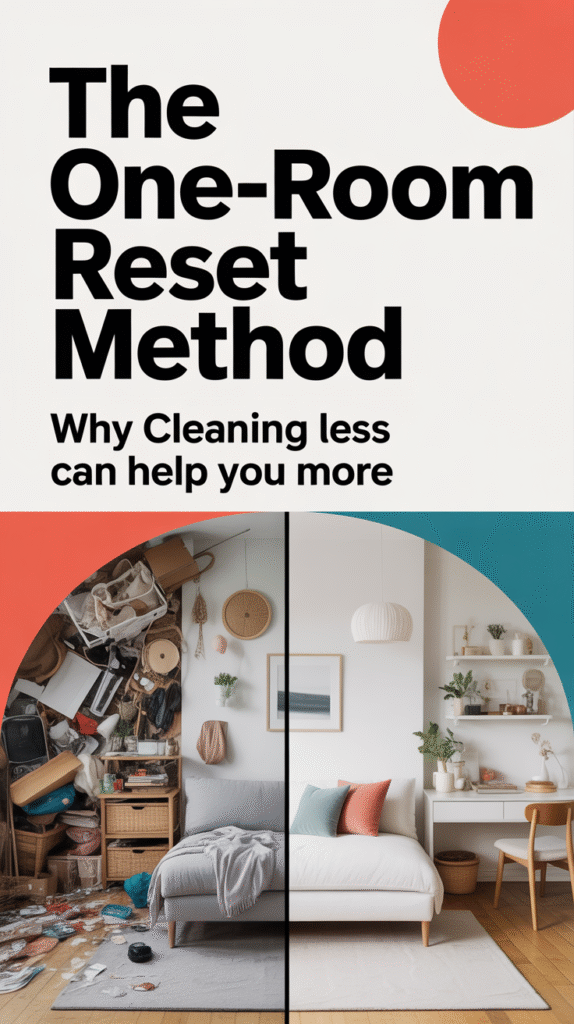
You know what’s funny?
People think productivity is about doing more.
More tasks. More routines. More cleaning. More organizing. More “I’ll finally get my life together today.”
But here’s the truth nobody tells you: Most people aren’t unproductive because they’re lazy. They’re unproductive because their brain is overwhelmed.
And that’s exactly why the One-Room Reset Method works so insanely well.
It’s the simplest productivity strategy I’ve ever used — and ironically, it happened on a day I was too exhausted to clean anything at all.
So, if you’re tired of feeling behind, distracted, or stuck in a loop of chaos… this method might change more than your space. It might change how your brain actually functions.
Why Your Brain Loves “Less” Instead of “More”
Your brain has a limited amount of mental bandwidth. When you look at a messy house, your brain doesn’t see “a mess.” It sees decisions, effort, time, energy, guilt, failure, and overwhelm all at once.
That’s why the idea of “cleaning the whole house” shuts you down before you begin. But when your brain sees one small, contained area? It feels doable. It feels winnable. It feels safe to start.
This is called task minimization — shrinking the goal so the brain stops panicking. When your environment is chaotic, your mind becomes chaotic. Cognitive load increases. Decision fatigue spikes. Motivation drops.
But when just one space is clean, your brain experiences something called a “micro-success trigger.” This tiny win fools your brain into feeling capable. And once that happens? Momentum begins.
The Science Behind the One-Room Reset
Three scientific principles make this method powerful:
The Zeigarnik Effect: Your brain hates unfinished tasks. Completing one room creates closure, which reduces mental stress and frees up cognitive resources.
Decision Fatigue Reduction: Cleaning an entire home demands hundreds of decisions about what to do, where to start, what to keep, and where things go. Cleaning one room demands maybe 20 decisions. This conserves your mental energy for things that actually matter.
The Momentum Loop: A small win triggers dopamine, which increases motivation. This dopamine cycle is what makes you suddenly want to clean more after finishing just one space. It’s not willpower — it’s brain chemistry.
How to Choose the Right Room
The easiest way? Choose the room that stresses you out the most.
Not the messiest. Not the biggest. Not the easiest.
The room that raises your heart rate when you walk into it.
For most people, that’s either the bedroom, the kitchen, or the office. This becomes your “reset zone” — the place your mind returns to for clarity. When this one space is clean, everything else feels more manageable.
What Happens in Your Brain After a Reset
When just one room is clean, your brain experiences reduced cortisol (the stress hormone), increased control signals, higher cognitive processing, reduced visual noise, and better emotional regulation.
In simple words: Your brain finally gets to breathe.
That’s why people say, “I cleaned my room and suddenly my whole life felt manageable.” They’re not being dramatic — it’s neurological. A clean space creates mental space. Visual clutter translates directly into mental clutter, and your brain is constantly processing everything in your field of vision, even when you’re not consciously aware of it.
How This Method Makes You More Productive
Here’s what the One-Room Reset leads to:
You think clearer. You make decisions faster. You feel calmer. You reduce overwhelm. You start tasks more easily. You stay motivated longer.
And the biggest benefit? You break the cycle of “all or nothing.”
The house doesn’t need to be spotless. Your life doesn’t need to be perfect. Your space doesn’t have to look like Pinterest.
You just need one win. One room. One reset. One moment where your brain feels in control again.
That’s enough to change your day — and sometimes, your whole mood.
How to Actually Do It
Start tomorrow morning. Before you check your phone, before you make coffee, before you do anything else — spend 15 minutes on your chosen room.
Don’t aim for perfect. Aim for better.
Make the bed. Clear the surfaces. Put away the obvious clutter. That’s it.
Then watch what happens. Watch how that one clean space becomes a mental anchor throughout your day. Watch how it makes other tasks feel less overwhelming. Watch how your brain starts to believe it can handle things again.
The One-Room Reset isn’t about cleaning. It’s about giving your brain proof that you’re capable of creating order in chaos.
And once your brain believes that? Everything else starts to shift.